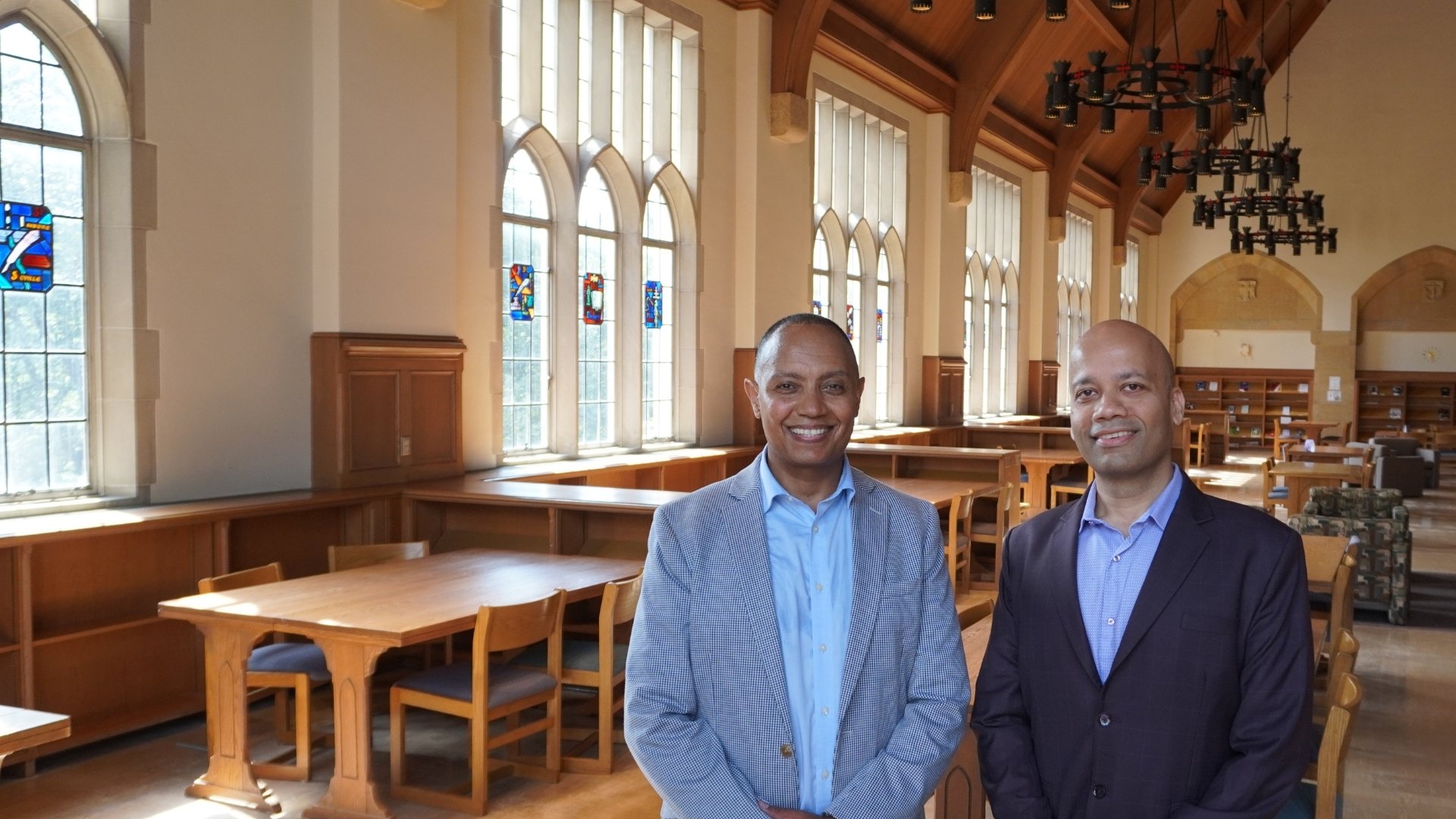
Article written by Doug Stone
Two Missions, One Belief
Two Missions, One Belief: Building Human Capital Through Access to Education
Jote Taddese and Dr. Manjeet Rege have spent years working on what looks, on the surface, like two very different projects. One moves books across oceans. The other moves careers forward in classrooms in St. Paul. Look closer, and it is the same project, built on the same conviction: give people access to knowledge and the tools to use it, and they will build something extraordinary.
Taddese, a native of Oromia, Ethiopia, came to the United States as a college student and went on to build a technology career at some of Minnesota's largest companies, including Target, Medtronic, and Optum Technology/UnitedHealth Group, specializing most recently in AI enabled digital platforms. Rege has spent more than two decades building a different kind of platform, one made of curriculum, research, and mentorship, as Professor and Chair of the Department of Software Engineering and Data Science at the University of St. Thomas, where Taddese earned his own Master's degree years ago.
"Africa's future will be built on innovation, and innovation starts with access. That is the thread connecting everything I do. Africa is the youngest continent on earth, with hundreds of millions of young people ready to build if they are simply given the tools. Through Books For Africa, we put the raw materials of learning into their hands. Alongside Dr. Manjeet Rege at St. Thomas, I help shape how the next generation of engineers is trained to build alongside them. Whether the work happens across Africa or here in St. Paul, it is the same mission: growing the human capital that an innovation economy runs on."
A Life Built Around Books
For nearly a decade, Taddese has volunteered with Books For Africa a St. Paul-based nonprofit, helping fundraise and organize the shipment of more than 200,000 books to students in Ethiopia. He currently serves as the organization's Board Secretary and previously served as its president.
His latest project is raising funds to ship books to the Onesimos Nesib Library in Hurumu, Oromia, Ethiopia, a library built through a local initiative in cooperation with Mattu University. A container of some 20,000 books, covering STEM subjects, life sciences, humanities, and English language literacy materials, will support students, teachers, and community members there. Last year, Taddese helped raise $15,000 and organize the shipment of 35,000 books to a library in Addis Ababa, ranging from elementary readers to a law library, medical texts from Merck, and a Girls' Empowerment collection.
The idea for the Hurumu project took shape during a visit to Ethiopia's Abrehot Library in December 2024 with his wife and three children. Abrehot is the largest library in East Africa and among the top ten on the continent, architecturally striking and home to thousands of research papers. Yet as Taddese and his family walked through its four floors, they found the collection itself was severely lacking.
"Just the quality of the books in the library did not meet the architectural magnificence of the building itself," he said.
Within weeks of returning to Minnesota, Taddese had activated his global network to raise funds and awareness, working with partners at the library to get books moving by the end of 2025. When the shipment finally departed by cargo ship for Ethiopia in early November, he said with a smile, "It looks like Christmas has arrived early."
"We live in the age of AI, but books are so important when it comes to the foundations of learning, the culture of learning, the culture of reading, the culture of building intelligence, the culture of building wisdom," Taddese said. "It's all anchored around books. If it wasn't for books, I wouldn't be here today. Many of us wouldn't be where we are today."
He added that the work carries a personal weight. "I've experienced book scarcity, where I grew up, when I was a young boy, and knowing what it would mean for students and teachers and community members to walk into the library and find all these exciting books to learn from, I can relate to that,” he said. “I can connect to that because I was one of them."
"We live in the age of AI, but books are so important when it comes to the foundations of learning, the culture of learning, the culture of reading, the culture of building intelligence, the culture of building wisdom. It's all anchored around books. If it wasn't for books, I wouldn't be here today. Many of us wouldn't be where we are today."
A Career Built Around the Same Belief, at Scale
Where Taddese's work has centered on getting books into hands, Rege has spent his career building the systems and institutions that turn access into opportunity at scale, often reaching well beyond St. Paul in the process. In 2017, a St. Thomas data science graduate student named Souleymane Kone secured a two-year, two-million-dollar grant to bring data analytics capabilities back to his home country, Ivory Coast, and then approached Rege to travel there and train a core team in data science and machine learning. Rege made the trip over three separate visits. That team went on to train more than 120 "data fellows" across the country.
"The emphasis for him and all of this is the positive impact it's having in Africa," Rege said of Kone's mission at the time. "That really connects with our mission here of advancing the common good." (St. Thomas Newsroom, 2019)
That same commitment to reach and access closer to home earned Rege recognition in 2025, when the Minnesota Technology Association named him Tech Educator of the Year at its annual Tekne Awards, an honor given to educators whose impact on technology education reaches well beyond their own classroom. St. Thomas President Rob Vischer, who spoke at the celebration, credited Rege for lending "his considerable gifts, expertise and passion for learning" to students. (St. Thomas Newsroom, 2025)
Over more than 20 years in AI and data science, Rege has authored more than 100 peer-reviewed publications and written the book "Ethics and Governance of Artificial Intelligence: Frameworks, Risks and Society." Woxsen University in Hyderabad, India, honored Rege by opening a lab and a Chair Professorship named after him, extending his work in AI education well beyond St. Paul. He also regularly serves as a keynote speaker, media commentator, and advisor to organizations navigating AI strategy and adoption.
At St. Thomas, Rege leads a portfolio of four graduate programs, the MS in Information Technology, MS in Software Engineering, MS in Data Science, and MS in Artificial Intelligence, all designed with the same access minded philosophy that drives Taddese's work overseas.
"These programs are not built only for people who already have a technical background," Rege said. "They are built for anyone who is ready to change lanes and advance their career, whatever their starting point. Removing that barrier to entry is one of the things I am proudest of in how we've designed this."
Keeping four graduate programs current in a field that reinvents itself every few years takes outside perspective, which is why Rege relies heavily on the department's Strategic Advisory Board, now chaired by Tadesse.
"The Board keeps us on the pulse of what's actually happening in industry, not what was happening two years ago," Rege said. "It was the Board's guidance that led us to launch the MS in Data Science back in 2014, long before data science was a mainstream term, and their guidance again that pushed us to launch the MS in AI in early 2024. Without that outside perspective, we would always be a step behind."
Two Leaders, One Mutual Respect
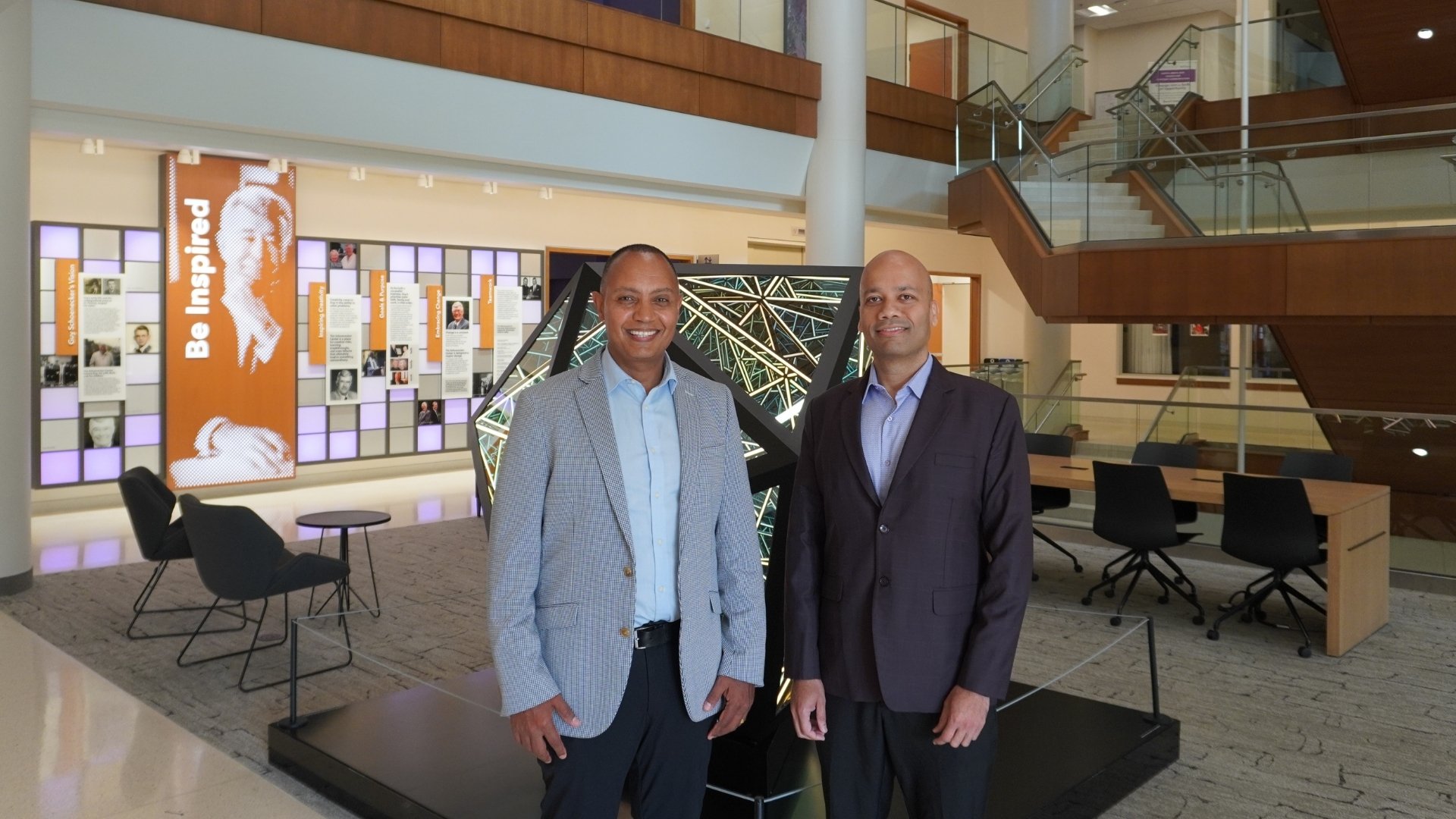
Taddese's own path back to St. Thomas, as a graduate turned Board Chair, is not lost on Rege. "Jote is a perfect example of what this program can do," Rege said. "He came through as a student, built a strong career in industry, and now he has come back to make sure the next generation gets an even better version of what he got. That is not something you can manufacture. It comes from someone who genuinely believes in the work."
Taddese describes Rege's leadership in equally direct terms. "Manjeet doesn't run this program like something to protect. He runs it like something to keep rebuilding," Taddese said. "Most academic leaders would have been content once the program had a good reputation. Manjeet is the one who calls the Board and asks what we're missing, what's already out of date, what the industry needs that we haven't built yet. That restlessness is rare, and it's exactly what a program like this needs to stay relevant."
"Manjeet has been such a great ambassador for this program," Taddese said. "He doesn't just lead it from behind a desk, he's out there representing it, in front of industry, in front of students, in front of anyone who needs to understand why it matters. People trust the program because they trust him."
He pointed specifically to how deliberately the program is built for access. "A lot of programs say they're open to anyone. Manjeet actually designs for it," Taddese said. "He built something that gives people a real path in, no matter where they're starting from, and he keeps widening that path for the next person. That kind of intentional access is not a small thing, and it's not an accident either."
Where the Two Missions Meet
The clearest bridge between the two men's work came when Taddese invited Rege to speak to the Books For Africa board on the topic of AI for nonprofits. Rege said yes without hesitation.
"When Jote asked me to speak to the Books for Africa board about AI for nonprofits, I said yes right away, because it is really the same conversation I have with my own students, just in a different room," Rege said. "Nonprofits are being asked to do more with fewer resources than ever, and AI can help level that playing field if people understand how to use it well. Standing in that room made something clear to me. What I am doing here at St. Thomas and what Jote is doing across Africa are not two separate missions. They are the same mission, just applied in different places."
Taddese remembers it the same way. "He didn't just show up, he prepared something that genuinely helped organizations doing hard work with limited resources," Taddese said. "That told me this isn't a side interest for him. He sees the same mission I see: give people the tools, and they'll build something extraordinary. It didn't matter that the room was Books for Africa and not a classroom in St. Paul. He showed up the same way either way."
A Shared Legacy, in Two Directions
Taddese has called Minnesota home for nearly 30 years, raising three sons in Plymouth with his wife while staying closely connected to family and friends back in Ethiopia. "There's that saying that charity begins at home," he said. "Well, to me, the ability to be a positive force for communities thousands of miles away, that's a huge inspiration to me personally. I'm hoping others will see that and become the force of change, the force of impact that they want to be for their own respective community."
Rege's own reach tells a parallel story of impact extending well past a single campus, from the classrooms and research he leads at St. Thomas, to the analytics lab and named chair he holds at Woxsen University in India, to the organizations he advises on AI strategy around the world.
Asked what he hopes graduates of the St. Thomas program carry with them, Rege points to something broader than any single skill. "If there is one thing I want every graduate of our program to walk away with, it is the ability to solve a problem nobody has handed them the answer to yet," he said. "That is what the world actually needs from this generation, and that is what we are building here."
For Taddese, the work is a continuation of a debt he feels compelled to repay, in whichever direction it is needed. "This program gave me a path I did not have before," he said. "Now I get to help make sure that path is there for someone else, here and everywhere else in the world where it is needed."
Article written by Doug Stone, Doug Stone Communications, LLC.