“An Artificial intelligence-driven world is fundamentally altering our workforce and people need to prepare themselves to stay in-demand” - Authors

A real smart path for future jobs
Artificial Intelligence and the future of work
by: Dr. Manjeet Rege and Dan Yarmoluk
Learn how an artificial intelligence-driven world is fundamentally altering our workforce—and what you can do to prepare yourself to stay in-demand.
Everywhere you turn, technology and automation are colliding, fundamentally altering the ways we live and work. From the grandiose—autonomous vehicles and robotic surgeries—to the daily interactions of Alexa, Siri, and Netflix recommendation systems, it’s hard to find an aspect of our lives automation hasn’t touched.
This revolution relies on a complex array of technology layers. However, it is artificial intelligence (AI) at the center when it comes to creating truly intelligent systems. But what does a future driven by AI look like? And, more importantly, what challenges and opportunities does AI present for our future workforce?
How is automation shifting the workforce?
Automation and technology have shifted work in pursuit of lowering costs, increasing efficiency and production. From robotic warehouses and chatbots to automated customer service, the entire economic class of low-wage workers is being wiped out.
As technology continues changing and evolving, skills and jobs as we know them will need to change. Warnings suggest AI could lead to the loss of tens of millions of jobs.
In fact, Elon Musk predicts: Computers, intelligent machines, and robots seem like the workforce of the future. And as more and more jobs are replaced by technology, people will have less work to do and ultimately will be sustained by payments from the government.
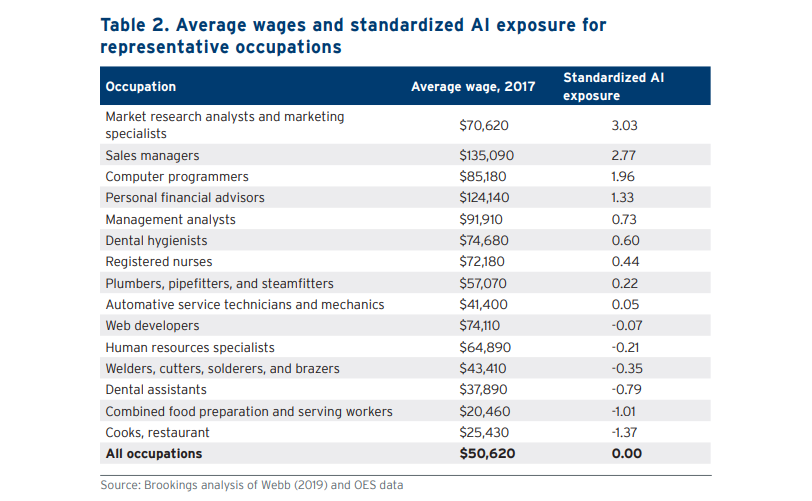
Average wages and standardized AI exposure for representative occupations
As noted in Table 2, at the high end of AI involvement are more well-paid occupations that are often analytic or supervisory and may therefore be especially susceptible to the emergence of AI.
Isn’t change in the labor force inevitable?
This isn’t the first time technology has displaced workers and altered industries. After the widespread adoption of the car, work was hard to come by for those in the horse trades. And electricity and fluorescent lighting displaced gas lamps. Jobs have shifted in the past, but what makes the current shift so prominent is the speed at which it is happening.
The question now isn’t if automation will impact your industry. But when. A recent report by MIT-IBM Watson AI Lab shed light on the changing nature of work. The report noted tasks that can be done by machine learning are much broader in scope and the skills in most demand will change. As technology reduces the cost of some tasks, the value of remaining tasks, particularly soft skills such as creativity, common sense, judgment and communication skills, is increasing in value.
At the University of St. Thomas, we built our data science program on a very simple philosophy: Change or become irrelevant. Our curriculum is not only built with industry partner collaboration and the Center of Applied A.I., but we update courses several times a year to stay ahead of the rapidly evolving needs of the current and future data scientist.
We truly believe AI is the future, so we view it as mission-critical to prepare students with the tools they need to accelerate their careers and succeed in this fast-changing technological world.
The question now isn’t if automation will impact your industry. But when.
Authors
What sectors of the labor market are changing the most?
The media and scholars are quick to say “the vulnerable will be the most vulnerable” and note better-educated workers will fare better as AI/automation spreads. A recent McKinsey report forecasted 800 million global workers could be replaced by robots by 2030. The report goes on to suggest that those with blue-collar jobs, such as machine operation, and workers in warehouses and fast-food establishments, are particularly susceptible to disruption.
But a new study published by the Brookings Institution cautions this might not be the whole picture. The report looked at thousands of AI patents and job descriptions and found that AI could affect work in virtually every occupation group, however, educated, well-paid workers may be affected even more by the spread of AI.
Workers with a bachelor’s degree, for example, would be exposed to AI over five times more than those with only a high school degree.
This results from the fact AI is strong at completing tasks that require planning, learning, reasoning, problem-solving, and predicting—most of which are skills we think of as white-collar jobs. AI is one of the biggest challenges facing business leaders today. Partnering with organizations like the Center for Applied Artificial Intelligence to leverage expertise, development of in-house skills-based training courses, or utilizing resources through universities that provide experiential learning are critical strategies to help continually train and reskill people to be ready for the changing landscape AI creates.
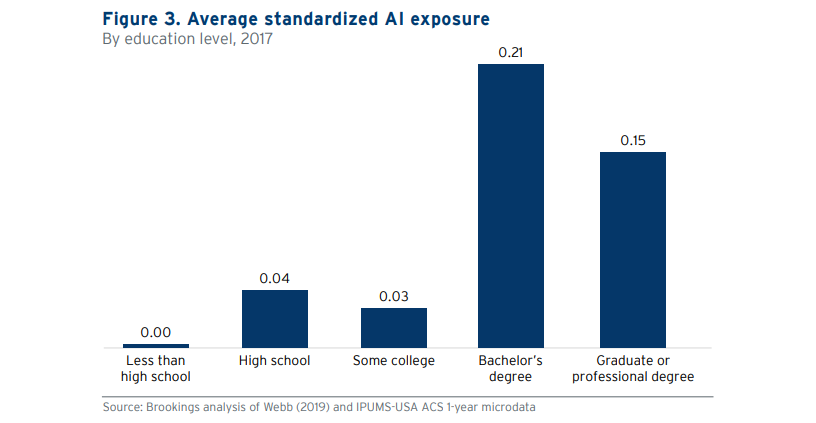
Average standardized AI exposure
Figure 3 suggests that AI’s impacts will not be equally distributed, and that it will have a very different set of impacts than the broader array of automation technologies (dominated by robotics and software).
What are the keys to staying ahead in the labor market?
Our frame of reference is being disrupted like never before. And that requires all of us being comfortable with the uncomfortable. The key to that is readily adapting to change, continuing education, and reskilling.
IBM reports that more than 120 million workers globally will need retraining in the next three years due to artificial intelligence’s impact on jobs.
Skills in new coding languages, cloud architecture, cybersecurity, machine learning, artificial intelligence, API integration are in high demand as companies require virtual environments and automation in digital transformation across all industries.
This means we also need to reframe our educational systems to best prepare workers for the jobs of the future. That requires using all the tools and resources we have at our disposal. At the University of St. Thomas, learning and development remotely, in-person or hybrid approaches are key to providing opportunities to all potential students.
AI’s impact on the workplace, the future of work, sectors of the economy, and global domination are hard to assess. What we do know is that the nature of work will change, disruption will occur in sectors of the economy, and we should brace for that change. Here at the University of St. Thomas, we are working to ensure all our students and graduates have the skills and training needed for in-demand skills and are prepared to thrive in the rapidly evolving workforce.
Author bios:

Manjeet Rege is an associate professor of Graduate Programs in Software and Data Science and director of the Center for Applied Artificial Intelligence at the University of St. Thomas. Dr. Rege is an author, mentor, thought leader, consultant, and a frequent public speaker on big data, machine learning, and artificial intelligence technologies.

Dan Yarmoluk is an adjunct faculty member in the Graduate Programs in Software at the University of St. Thomas. He has been involved in analytics, embedded design and components of mobile products for over a decade. He has focused on creating and driving IoT automation, condition monitoring and predictive maintenance programs with technology, analytics and business models that intersect to drive added value and digital transformation.